
Think it could be meningitis? Call 999 or go to A&E now. Do not wait for a rash.
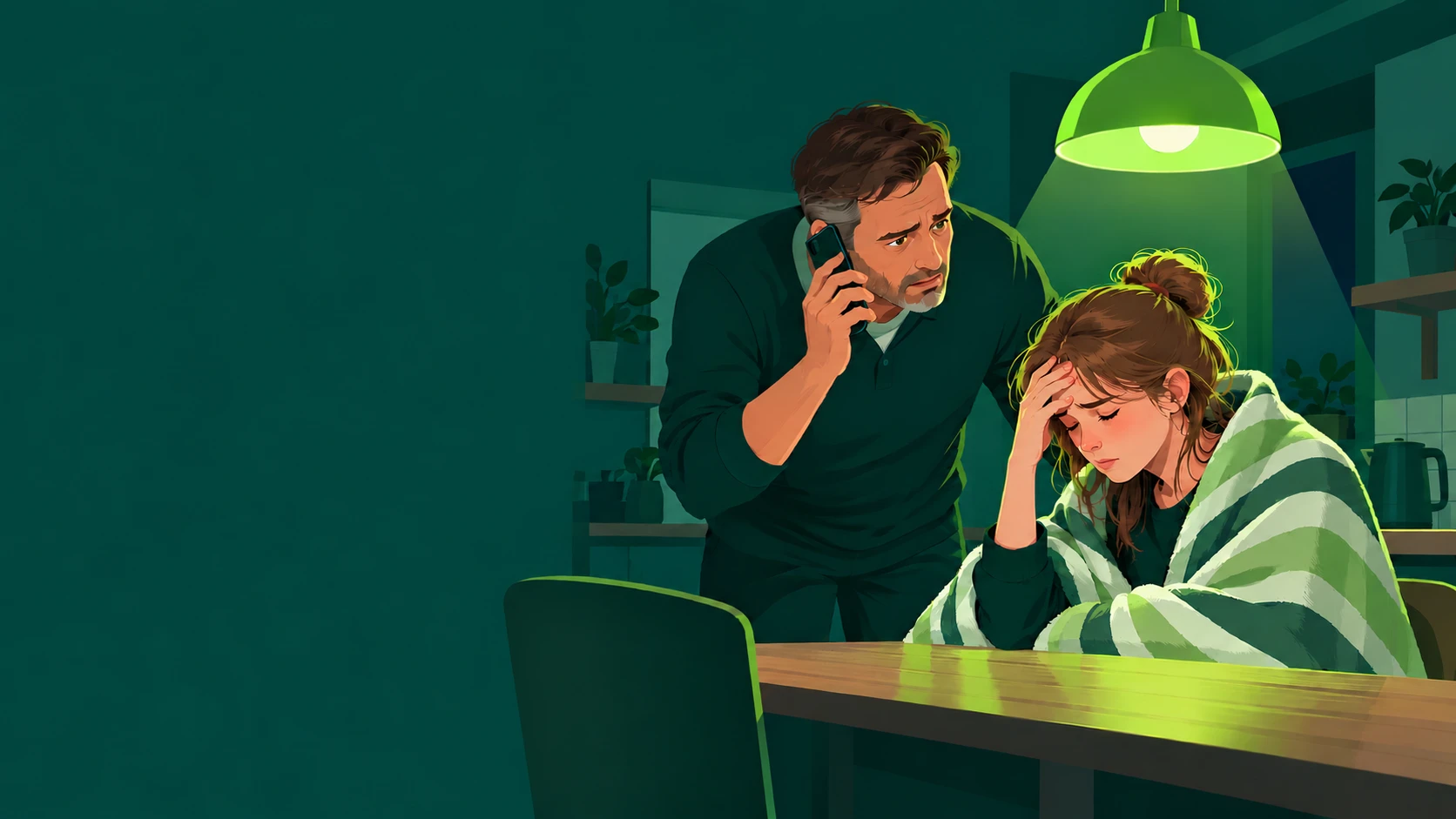
Meningitis: do not wait for a rash
Meningitis is an infection of the protective layers that cover the brain and spinal cord. It can be very serious and even life-threatening if not treated quickly.
Source: NHS website – Meningitis (opens in a new tab). Information from the NHS website.
“Do not wait for a rash”: NHS inform – Meningitis (opens in a new tab); NHS 111 Wales – Meningitis (opens in a new tab)
When to call 999 or go to A&E
Call 999 or go to A&E if an adult or child aged 5 years or over:
- has a very high or very low temperature, feels hot or cold to the touch, or is shivery
- has a very painful headache
- is confused, has slurred speech, or is not making sense
- has a stiff neck and cannot look at bright lights
- has a rash that does not fade when you press it
- has a seizure (fit) for the first time
- has symptoms you're worried might be meningitis
Call 999 or go to A&E if a baby or child under 5 years:
- has a very high temperature – 38°C or more in babies under 3 months old, or 39°C or more in babies 3 to 6 months old
- has a very low temperature – less than 36°C, or feels cold to the touch or is shivery
- has a weak, high-pitched or continuous cry
- has a rash that does not fade when you press it
- is not responding like they normally do, is not feeding, or is floppy, difficult to wake or more sleepy than usual
- has symptoms you're worried might be meningitis
Do not drive yourself to A&E. The person you speak to at 999 will give you advice about what to do.
Source: NHS website – Meningitis (opens in a new tab). Information from the NHS website.
Trust your instincts. A child or adult with meningitis might not have every symptom listed. Get immediate medical help if you or your child are unwell and you think there's something seriously wrong.
Source: NHS website – Meningitis (opens in a new tab). Information from the NHS website.
If you've already had medical advice but remain worried or symptoms worsen, seek medical help again.
Symptoms of meningitis
The symptoms of meningitis develop suddenly and can include:
- a high temperature (fever)
- very cold hands and feet
- a stiff neck
- joint and muscle pain
- a severe headache that is getting worse
- eye pain when looking at bright lights
- seizures (fits)
- vomiting (being sick) and diarrhoea
- confusion
- being very sleepy or difficult to wake
- spots or a rash that does not fade when pressed with a glass (this may be harder to see on brown or black skin)
Babies and children under 5 years may also:
- not want to feed
- have a high-pitched, unusual cry
- have a stiff body or be floppy or unresponsive
- have a bulging soft spot on the top of their head
Some of the early symptoms of meningitis can be similar to flu, a stomach bug or a hangover.
The meningitis rash
Not everyone with meningitis gets spots or a rash, but it's important to know what to look for.
The rash usually starts as small red pinpricks before spreading quickly and turning into red or purple blotches.
The rash does not fade if you press the side of a clear glass firmly against the skin.
The rash can be harder to see on brown or black skin. Check paler areas, such as the palms of the hands, soles of the feet, roof of the mouth, whites of the eyes or inside the eyelids.
Source: NHS website – Meningitis (opens in a new tab). Information from the NHS website.
Look out for friends
If a friend goes to bed unwell, check on them regularly.
If you are worried someone in hospital is getting worse
Tell the care team if you are worried that someone in hospital is getting worse.
If you remain worried and feel your concerns are not being addressed, you can request a rapid review by a different team through Martha's Rule, where it is available.
Ask hospital staff for the Martha's Rule phone number, or look for it on hospital posters or the hospital's website.
Martha's Rule is being introduced in adult and children's hospital wards in England. It is not yet available in every hospital or on every ward.
You can also ask for a second opinion about a diagnosis or treatment plan. This is separate from Martha's Rule.
What causes meningitis?
Meningitis can be caused by many different types of viruses or bacteria, which are spread through close contact with a person who has them. For example:
- contact with the person's spit, such as kissing them, or sharing drinks or vapes
- being in close contact with the person for a lot of time, such as living in the same home
The infection is usually spread by people who carry these viruses or bacteria but are not ill themselves.
Who is at greater risk?
Although anyone can get it, meningitis is more common in:
- babies and young children
- teenagers and young adults
- older people
- people with a weakened immune system – for example, people with HIV or having chemotherapy
It's possible to get meningitis more than once.
Source: NHS website – Meningitis (opens in a new tab). Information from the NHS website.
In England, 378 cases of invasive meningococcal disease were confirmed by laboratory tests between July 2024 and June 2025.
Reducing your risk
Vaccines are one of the safest and most effective ways to protect you and your child against meningitis.
As part of the NHS vaccination schedule, children and teenagers are offered vaccines that protect against the main causes of meningitis, such as the MenB, MenACWY, pneumococcal, 6-in-1 and MMRV vaccines.
If you're not sure whether your or your child's vaccinations are up to date you can:
- use the NHS App to view your vaccination history
- ask at your GP surgery
Source: NHS website – Meningitis (opens in a new tab). Information from the NHS website.
MenB vaccine for babies
Children are offered 3 doses of the MenB vaccine as part of the NHS vaccination schedule. They're offered the vaccine with other routine vaccines at:
- 8 weeks old
- 12 weeks old
- 1 year old
If your child has missed any of their MenB vaccines, contact their GP surgery. They can still have the MenB vaccine up to the age of 2.
The MenB vaccine does not protect against other causes of meningitis and sepsis, so it's still important to be aware of the symptoms.
Source: NHS website – MenB vaccine for children (opens in a new tab). Information from the NHS website.
MenACWY vaccine for teenagers
Teenagers are usually given the MenACWY vaccine at school when they're 13 or 14 years old (school year 9). If you missed having the vaccine when you were at school, you can still get it up until the age of 25. Ask your GP about getting vaccinated.
If you're under 25 and you've not had the MenACWY vaccine before, you should ideally have it at least 2 weeks before starting college or university.
Although the vaccine is very effective, it does not prevent all types of meningitis, so it's still important to be aware of the symptoms of meningitis even if you've been vaccinated.
Source: NHS website – MenACWY vaccine (opens in a new tab). Information from the NHS website.
MenB vaccine for young people, until March 2027
Until March 2027, the MenB vaccine is offered to young people who were born:
- between 1 September 2007 and 31 August 2008
- on or after 21 July 2001 and are starting university, or starting at some further education colleges for the first time in autumn 2026 and living at further education accommodation
First doses are available until 31 December 2026. Second doses are available until 31 March 2027. Two doses of the MenB vaccine are important for protection.
Source: NHS website – Meningitis (opens in a new tab). Information from the NHS website.
The MenB vaccine is given in 2 doses, which need to be at least 4 weeks apart.
- To book online you must be registered with a GP surgery in England.
- You can find a pharmacy walk-in site to get a MenB vaccination without an appointment; you do not need to be registered with a GP.
- You can call 119 free of charge to book over the phone if you cannot book online.
- In Wales, Northern Ireland and Scotland, use your local NHS MenB vaccination service.
Source: NHS website – Book a MenB vaccination appointment (opens in a new tab). Information from the NHS website.
Treatment and recovery
The treatment for meningitis depends on whether it's caused by a bacterial or viral infection. You'll need some tests in hospital to find out what's causing it.
Viral meningitis tends to get better on its own within 7 to 10 days. Viral meningitis does not usually cause any long-term problems and most people make a full recovery.
Bacterial meningitis needs to be treated in hospital, usually for at least a week. Bacterial meningitis is rarer but more serious. It may cause long-term problems such as:
- hearing or vision loss
- seizures (fits)
- problems with movement and co-ordination
- problems with memory and concentration
Bacterial meningitis can be fatal.
Source: NHS website – Meningitis (opens in a new tab). Information from the NHS website.
Follow-up care after bacterial meningitis
After bacterial meningitis or meningococcal disease, NICE recommends that you are offered:
- a hearing assessment within 4 weeks of being well enough for testing, preferably before you leave hospital
- a review with a hospital doctor 4 to 6 weeks after leaving hospital, or with a paediatrician for babies, children and young people
Before you go home, the hospital should explain how to get support, including contact details of meningitis charities.
Source: NICE – guideline NG240, recommendations 1.11.5, 1.12.7, 1.13.1 and 1.13.2 (opens in a new tab)
More information
- NHS website – Meningitis (opens in a new tab)
- NHS website – NHS vaccinations and when to have them (opens in a new tab)
- UK Health Security Agency – Meningitis patient factsheet (opens in a new tab)
- NHS inform (Scotland) – Meningitis (opens in a new tab)
- NHS 111 Wales – Meningitis (opens in a new tab)
- nidirect (Northern Ireland) – Urgent and emergency care services (opens in a new tab)
Charities that can help
Meningitis Now (registered charity 803016, England and Wales; SC037790, Scotland)
A charity providing information and support services for anyone affected by meningitis.
- Get support from Meningitis Now (opens in a new tab)
- Helpline: 0808 80 10 388 (freephone), [email protected]. This is a support line, not an emergency line.
Meningitis Research Foundation (registered charity 1091105, England and Wales; SC037586, Scotland)
A charity providing information and support services for anyone affected by meningitis.
- Get support from Meningitis Research Foundation (opens in a new tab)
- Helpline: 080 8800 3344 (freephone). This is a support line, not an emergency line.
Source for the charity descriptions: NHS website – Meningitis (opens in a new tab)
Back to stroke, sepsis and meningitis
This page is for signposting only. All information comes from the sources linked beside it. In an emergency, call 999. For urgent medical advice when it is not an emergency, use NHS 111 (opens in a new tab) in England, NHS 24 on 111 (opens in a new tab) in Scotland or NHS 111 Wales (opens in a new tab). In Northern Ireland, contact your GP or GP out-of-hours service (opens in a new tab).
Contains public sector information licensed under the Open Government Licence v3.0. Sources last checked: 21 October 2026.